Most small business owners have seen the little chat bubble in the corner of a website by now. Some have tried one that felt helpful. Others clicked it, asked a simple question, and got a canned reply that went nowhere. So when the topic of an AI chatbot for small business comes up, the honest question is usually: what does this thing actually do, and is it worth it for a company my size?
Here is the plain answer. A well-built AI chatbot is very good at a few specific jobs and poorly suited to others. If you understand that split before you buy, you get a tool that saves you time and sends you better leads. If you skip it, you get a gadget that frustrates visitors and quietly costs you business.
What an AI chatbot is really for
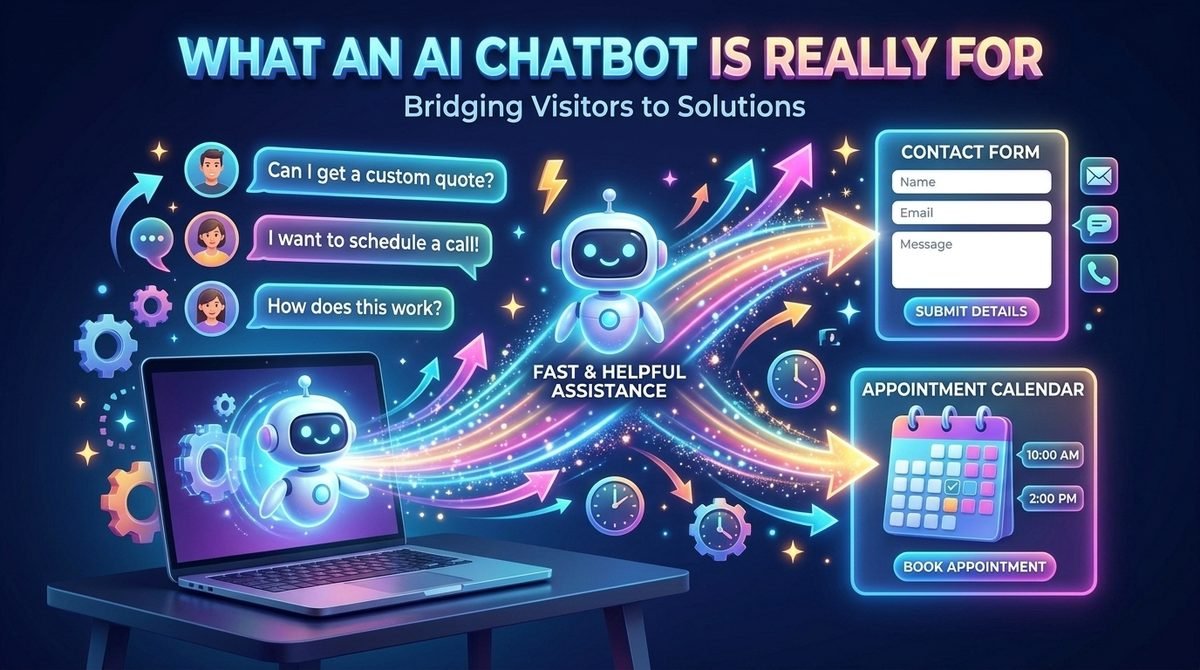
A website chatbot is not a salesperson, and it is not a replacement for you. Its job is to meet a visitor at the exact moment they have a question and give them a fast, accurate answer, so they keep moving toward contacting you instead of leaving.
That matters because people who land on your site are usually looking for something they genuinely need. They want to know quickly whether you are the right fit. A good chatbot tells them what you do, and just as importantly, what you don't do. That second part saves everyone time. A visitor who learns in thirty seconds that you don't offer a particular service is a visitor who doesn't fill out a form, wait two days for a callback, and walk away annoyed.
At Build A Better Website, this is how we frame every chatbot project:
"It's not necessarily built to replace human contact. It satisfies our current state of the internet, with short attention spans and the need for immediate answers, and then it's ultimately meant to encourage that user, if they did find what they were looking for, to make human contact."
Build A Better Website
That last part is the whole point. The chatbot handles the first conversation so that the second one, with a real person, starts in a better place.
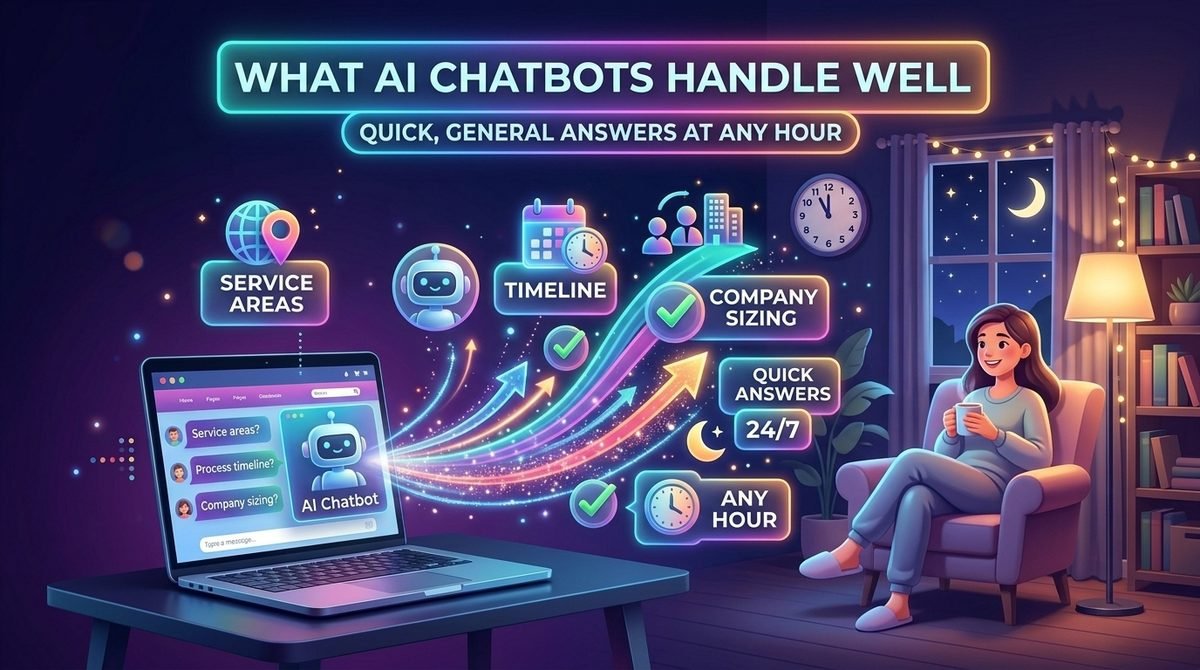
What AI chatbots handle well
Quick, general answers at any hour
Your business has a set of questions you answer over and over. What areas do you serve? Do you work with businesses my size? What does the process look like? How long does it usually take? A chatbot can answer these instantly, at 9 p.m. on a Sunday, without you lifting a finger. For an owner in Thousand Oaks or Camarillo who is already stretched thin, that is real time back in your week.
Qualifying and sorting visitors
Because the chatbot is clear about what you offer, it naturally filters the people who reach out. The leads who make it to your inbox or phone have already learned the basics and still want to talk. That makes for shorter, better conversations.
Pointing people to the right next step
This is where a chatbot earns its keep. Once a visitor has the answer they came for, the chatbot guides them to whatever your preferred point of human contact is. That might be:
- Your phone number, for businesses that close deals by talking
- A contact form or email, for people who prefer to write
- A scheduling link, so they can book a video call to discuss details
- Your shop address, if you have a brick-and-mortar location in Ventura or Oxnard and want them to come in
You choose the handoff. The chatbot just makes sure the visitor gets there.
Supporting short attention spans
People skim. They don't always want to read a full services page or dig through a menu. A chatbot lets them ask the one thing they care about in their own words and get a direct answer. That fits how people actually browse today.
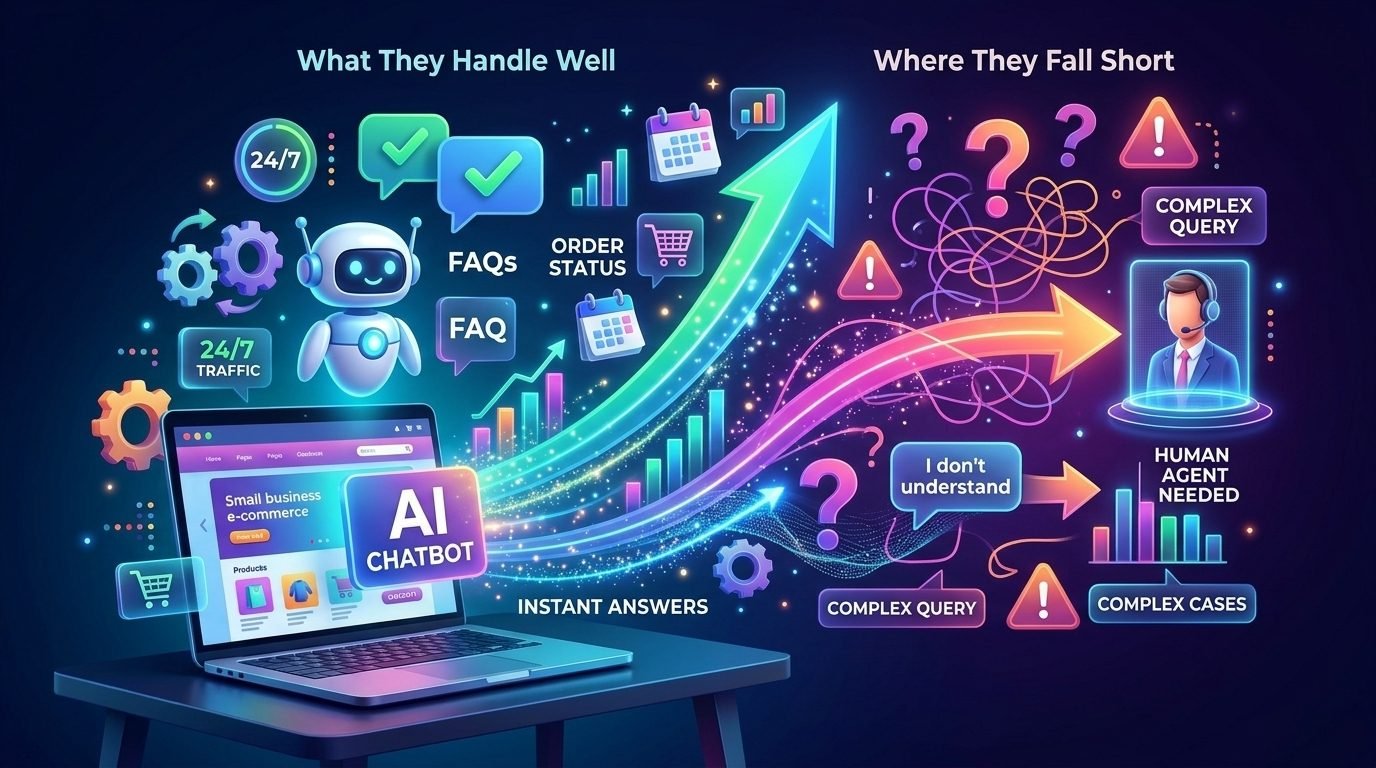
Where AI chatbots fall short
Closing the deal
A chatbot is purposely not built to close the sale. Could one technically take a visitor through a purchase? In some cases, maybe. But for most service businesses, the decision to hire you depends on trust, nuance, and a real conversation. Those are things a person does better. We design chatbots to warm up the lead, not to replace the moment where you earn the job.
Anything it wasn't taught
An AI chatbot only knows what you give it. If its knowledge is thin, outdated, or vague, its answers will be too. This is the most common reason chatbots disappoint: the business set it up once with a few paragraphs of text and never touched it again. When your pricing structure, hours, or services change, a neglected chatbot keeps giving the old answer with total confidence.
Complex or sensitive situations
A customer with a complaint, a billing problem, or a complicated custom request needs a human. A good chatbot recognizes those moments and routes the person to you quickly instead of trying to talk its way through them.
Making up for a weak website
A chatbot sits on top of your site. If the site itself is slow, confusing, or missing key information, a chatbot won't fix that. It works best on a site that is already clear about what you do.
The part most owners overlook: the chatbot's "brain"
Every AI chatbot draws its answers from a knowledge source. Often, that source is just a text file someone pasted in during setup. It works, but it's limited, and it's invisible to everyone except the chatbot.
There is a better approach. Instead of a hidden text file, you build a real knowledge base on your website: a searchable, database-driven library of articles, answers, and even blog posts. That gives you two wins at once.
First, accuracy. When the chatbot is set up to reference your website and your knowledge base for its answers, you know it is giving out correct, current information. The source of truth is something you can see and control.
Second, a second way to help visitors. Not everyone wants to chat. Some people prefer to type a keyword into a search bar and read an article on their own. A knowledge base serves both kinds of visitor: the ones who want a conversation and the ones who want to browse.
There is a third benefit that grows over time. When a new question keeps coming up, you write a new knowledge base article. The chatbot picks it up automatically, and the article is there for searchers too. Your chatbot gets smarter every time you add to the library, without anyone needing to retrain anything by hand.
This is the difference between a chatbot that slowly drifts out of date and one that stays sharp for years.
How to tell if your business is a good fit
An AI chatbot for small business tends to pay off when:
- You answer the same handful of questions many times a week
- Visitors often reach out without understanding what you offer
- Leads come in after hours and go cold before you can respond
- You have a clear next step you want people to take, like a call, a booking, or a visit
It's less useful when your business runs almost entirely on referrals and personal relationships, or when every inquiry is so custom that no general answer would help.
Questions to ask before you buy
If you're weighing options, these questions separate a useful chatbot from a frustrating one:
- Where does it get its answers? A pasted text file, or your website and a knowledge base you control?
- How do I update it? If changing an answer requires a support ticket, it will go stale.
- What happens when it doesn't know? It should hand off to a person, not guess.
- Where does it send people? It should point to your preferred contact method, whether that's a phone call, a form, a scheduled meeting, or your storefront.
- Is it honest about what we don't do? A chatbot that says yes to everything sends you bad leads.
The bottom line
An AI chatbot is a front-desk helper for your website. It answers quick questions, sets clear expectations, and steers interested visitors toward a real conversation with you. It isn't a closer, and it's only as good as the knowledge behind it. Build that knowledge properly, ideally as a searchable knowledge base on your own site, and the chatbot becomes a dependable part of how you win business across Ventura County and beyond.
If you want a chatbot that's built this way from the start, with a knowledge base you control and a handoff that fits how you like to work, take a look at our Conversations AI service.
Frequently asked questions
Will an AI chatbot replace my receptionist or sales team?
No. A well-designed chatbot handles quick, general questions and then encourages the visitor to contact a real person. It takes repetitive questions off your plate so the conversations you do have are with people who already understand what you offer.
How does the chatbot know what to say about my business?
It draws from a knowledge source you provide. That can be a simple text file, but the stronger approach is a searchable knowledge base on your website. When the chatbot references your site and that knowledge base, its answers stay accurate and you can update them yourself anytime.
What happens when a visitor asks something the chatbot can't answer?
It should hand the visitor off to you through your preferred contact method, such as a phone call, email, contact form, scheduled meeting, or an in-person visit. A good chatbot doesn't guess when it doesn't know.
Can I keep my chatbot's answers up to date without technical help?
Yes, if it's built around a knowledge base. When something changes or a new question keeps coming up, you write or edit an article, and the chatbot uses the updated information going forward.
Is an AI chatbot worth it for a very small business?
It often is if you answer the same questions repeatedly, get inquiries after hours, or have visitors who reach out without understanding your services. If nearly all your work comes from referrals and every job is fully custom, the benefit is smaller.