
If you're a small business owner shopping for a new website, you've probably noticed that nobody gives you a straight answer on price. One designer quotes a few hundred dollars. Another sends a proposal with a number that looks like a used car payment. A DIY builder says you can do it yourself this weekend. They can't all be right, and you still have no idea what you'd actually spend or when you'd see a site go live.
So let's cut through it. This guide covers what a small business website really costs, what pushes the price up, how long a build should take, and which questions to ask before you hand anyone your money. We've built more than 111 websites for small businesses, and almost every owner asks some version of these questions right before they decide who to hire.
The Short Answer
For most small businesses we work with, a website costs $200 a month, with a 6 month minimum. After that, you go month to month. Hosting and maintenance are built into that number, so you aren't stacking surprise invoices on top of it.
That's our pricing, not an industry standard, and we'll explain why we do it this way. But first it helps to know why the question "how much does a small business website cost" is so hard to answer in general.
Why Website Pricing Is So Hard to Compare
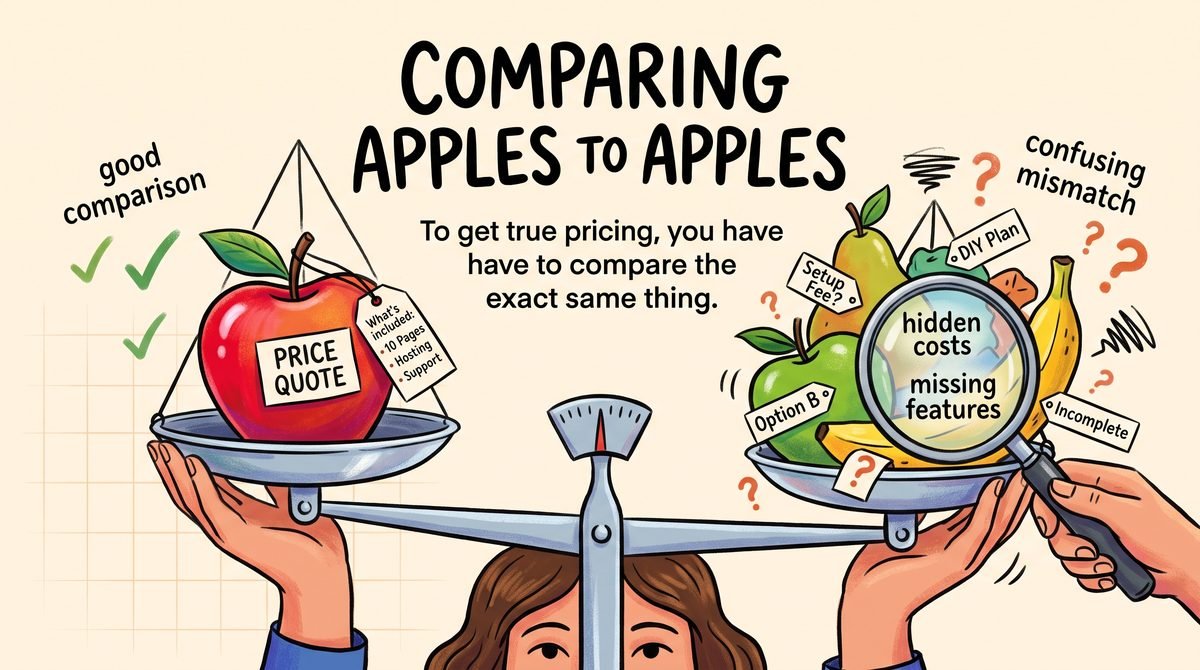
Website pricing feels all over the place because different providers bundle completely different things into the quote. When you compare two proposals, you're often comparing apples to a fruit basket.
Here are the most common ways designers and agencies charge:
- A large up-front project fee. You pay most or all of the cost before launch, often split into a deposit and a final payment. Hosting, updates, and support are usually billed separately afterward.
- A deposit plus milestones. Payments are tied to design approval, development, and launch. Clearer than one big check, but you're still paying for most of the site before it brings in a single lead.
- DIY builder subscriptions. A low monthly fee for the software, but you supply the time, the design skill, the copy, and the troubleshooting. Your hours have a cost too.
- Ongoing retainers. Common with larger agencies. These can be great for active marketing work, but they're often more than a small business needs just to get a solid site live.
None of these is automatically wrong. The problem is that a low headline number can hide a lot. A quote that leaves out hosting, security updates, or the cost of changing a page later isn't really the price of your website. It's the price of the first chapter.
When you compare quotes, ask each provider the same thing: what will I have paid in total after 12 months, including hosting, maintenance, and edits? That one question tends to clear up the confusion fast.
What Makes a Website Cost More
A straightforward business website with your services, your story, a way to contact you, and a few strong pages is the baseline. The price goes up when the site has to do more, not just say more.
The biggest cost drivers are:
eCommerce. Selling products online means product pages, a cart, checkout, payment processing, shipping rules, tax settings, and inventory. That's real functionality, and it takes real build time.
Membership systems. If customers need to log in to reach gated content, courses, or member pricing, the site needs accounts, permissions, and often recurring billing.
Custom admin tools. Some businesses need a back-end dashboard built around how they actually work, like a booking manager, a quote builder, or an internal tool for staff.
CRM or CMS integration. Connecting your site to a customer relationship manager, or building a content management setup so your team can update things themselves, adds setup and testing time.
If you need any of these, expect a project to cost more than the baseline. We talk through all of it in our initial Web Meeting, so you know where you stand before anything is built. Good providers should be able to tell you clearly which features change the price and by how much. If someone can't explain what you're paying for, that's a warning sign.
How We Price It (and Why)
Here's where we do things differently. We don't charge a fee up front.
Instead, we figure out what you need, factor in hosting and maintenance, and spread the cost over a 6 or 12 month period. For most clients, that comes out to $200 a month for a minimum of 6 months. After that, you're month to month.
The reasoning is simple. A new website is an investment you make so it brings in more business. Asking you to pay for all of it before it's earned anything puts all the risk on you. We'd rather carry that risk ourselves.
"You don't have to pay in full for the new website, it gets launched fast and this gives it a chance to pay for itself. The onus of success is on us. We are confident your new site will give your business a boost and if it can bring in more revenue than it costs you, everybody wins."
The Build A Better Website team
That's the core of it. If your site launches quickly and starts bringing in calls, form fills, or sales, it starts paying for itself while you're still on the monthly plan. You aren't sitting on a five-figure invoice and hoping it works out.
How Long Does It Take to Build a Small Business Website?
Timelines vary even more than prices. A simple site can be done quickly. A complex build with custom features takes longer. But in a lot of cases the real holdup isn't the code. It's everything around it.
Here's what usually slows a project down:
- Waiting on content. Photos, service descriptions, team bios, and testimonials. If these live in your head or scattered across old files, gathering them can take longer than the build.
- Unclear decisions. Without a clear picture of what the site needs to accomplish, projects drift through rounds of revisions.
- Too many approvers. When five people need to sign off on every page, each round takes a week instead of a day.
- Scope creep. A "quick extra feature" halfway through can reset the schedule.
Our approach is built to avoid that drift. We launch your new website within 30 days, before your second payment. That deadline keeps everyone focused, us included. You're not paying month after month for a site that's still "almost ready."
If you're talking to other designers, ask for a launch date in writing and what happens if they miss it. A provider who's confident in their process will give you a real date.
The Costs People Forget: Hosting and Edits
Owners ask us about hosting and edits all the time, and for good reason. These are the costs that tend to show up after launch, once you've already said yes.
Hosting is where your website lives on the internet. Every site needs it. Some providers mark it up, some leave you to set it up yourself, and some bundle it in. With us, hosting is factored into your monthly cost from the start.
Maintenance covers keeping the site secure, up to date, and running smoothly. A site that's never maintained gets slower and more vulnerable over time. Again, we build this into the monthly plan rather than billing it separately.
Edits are the changes you'll want after launch: a new service, an updated price, a seasonal promotion, a fresh photo. Every business changes, so your website should too. Before you sign with anyone, ask exactly how edits are handled and what they cost. We cover this in the Web Meeting so there are no surprises later.
Does the Platform Matter?
It does, and it's worth asking about. Many small business sites run on WordPress, which is popular and flexible, but it often depends on a stack of plugins that need constant updates and can slow the site down or open security gaps if they're neglected.
We build with modern frameworks like Astro and React. In plain terms, these sites tend to load fast, have fewer moving parts to break, and hold up better over time. Speed matters because visitors leave slow sites, and a site that loads quickly on a phone gives every visitor a better first impression of your business.
You don't need to become an expert on frameworks. Just ask your designer what they build on, why they chose it, and what upkeep it will need.
Questions to Ask Before You Hire a Web Designer
Whoever you end up working with, these questions will protect your budget and your timeline:
- What is my total cost over the first 12 months, including hosting, maintenance, and edits?
- Do I pay up front, or is the cost spread out?
- What is my launch date, and is it in writing?
- Which of my needs (eCommerce, memberships, integrations) change the price?
- What platform will the site be built on, and why?
- What happens after launch if I need changes?
- Can I see sites you've built for businesses like mine?
A good partner answers all of these clearly in the first conversation. If the answers are vague, keep looking.
How to Tell If Your Website Is Paying for Itself
A website isn't just a cost. It's a tool for bringing in revenue, and you should be able to see whether it's doing that.
After launch, watch for:
- Calls and form submissions that come from the site.
- Quote requests or bookings that mention finding you online.
- Sales, if you sell directly through the site.
- Fewer repeat questions, because your site now answers them before customers pick up the phone.
Here's the math that matters. If your site brings in even one or two new customers a month and those customers are worth more than the monthly cost, the site is paying for itself. That's the bar we hold ourselves to, and it's why we launch fast. The sooner the site is live, the sooner it starts working.
Whether you run a service business in Thousand Oaks, a shop in Camarillo, or a growing company anywhere in Ventura County, the goal is the same: a website that earns more than it costs, without draining your cash before it launches.
Ready to Find Out What Your Site Would Cost?
The fastest way to get a real number is to tell us what your business needs. We'll walk through your goals, flag anything that affects the price, and give you a clear monthly cost and a launch date. Learn more about our website development services and book your Web Meeting.
Frequently Asked Questions
How much does a small business website cost?
It depends on what the site needs to do. With us, most small business websites cost $200 a month for a minimum of 6 months, with hosting and maintenance included. After that, you go month to month. Sites that need eCommerce, memberships, custom admin tools, or CRM or CMS integration cost more, and we go over those details in your initial Web Meeting.
Do I have to pay for my website up front?
Not with us. We don't charge an up-front fee. We work out what you need, factor in hosting and maintenance, and spread the cost over a 6 or 12 month period. That way the site has a chance to start paying for itself before you've paid for all of it.
How long does it take to build a small business website?
We launch new websites within 30 days, before your second payment. In general, the biggest timeline factors are how quickly content like photos and service details is ready, how clear the goals are, and how many people need to approve each stage.
Are hosting and maintenance included in the price?
Yes. Hosting and maintenance are factored into your monthly cost, so you aren't hit with separate bills for keeping the site online, secure, and up to date.
What does it cost to make edits to my website after launch?
Edits depend on how often you need changes and how big they are. We go over how edits work for your business in the initial Web Meeting, so you know what to expect before the site is built. Whoever you hire, get this answered before you sign.